
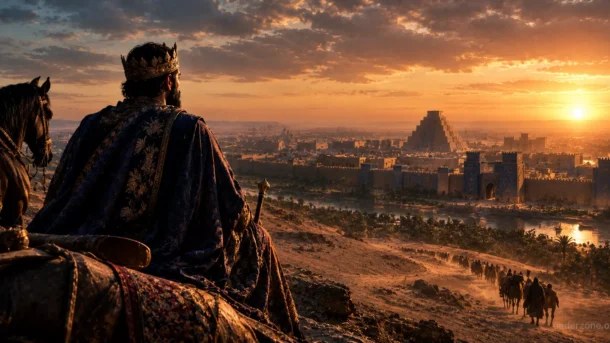
For nearly ten years, Babylon’s king lived far from his capital. Why he went there is still not entirely clear.
Imagine ruling one of the most powerful cities on Earth, surrounded by palaces, temples, and the wealth of an empire. Then imagine leaving it behind and spending almost a decade in a distant desert oasis.
That is what happened to Nabonidus, the last king of the Neo-Babylonian Empire.
Around 552 BCE, he left Babylon and eventually settled in Tayma, an oasis in what is now northwestern Saudi Arabia. He remained there for years while his son, Belshazzar, and royal officials stayed in Babylonia.
But why would a king abandon the heart of his own empire?
A King Far from Home
The Nabonidus Chronicle, an ancient cuneiform record, confirms his long stay in Tayma. It also describes military activity in Arabia, suggesting that the king’s absence was connected, at least in part, to his ambitions in the region.
Yet military expansion may not tell the whole story.
Nabonidus had an unusual religious devotion to Sin, the Mesopotamian moon god. His restoration of Sin’s temple at Harran, along with his religious policies, has led some scholars to suggest that tensions with Babylon’s influential priesthood may have contributed to his troubled reputation.
The exact reasons for his prolonged stay remain debated. Was Tayma primarily a strategic base for expanding his power? Did religious conflict play a role? Or were several motives involved?
The surviving evidence does not give us a simple answer.
What it does reveal is that the king’s absence had consequences. During several years of his stay, Babylon’s traditional New Year festival could not be celebrated in its usual form because the king and the relevant religious symbols were not present as expected.
For a civilisation in which kingship and religious ritual were closely connected, this was more than a missing celebration. It touched the relationship between the ruler, the gods, and the prosperity of the kingdom.
The Empire That Did Not Wait
In 539 BCE, Cyrus the Great conquered Babylon. Nabonidus was captured, and the Neo-Babylonian Empire came to an end.
His years in Tayma remain one of the stranger episodes in Babylonian history. We possess an ancient chronicle recording his absence, inscriptions connected with his reign, and evidence of his devotion to Sin. But none of these sources completely explains his decision to remain so far from home.
Perhaps the desert was the key to expanding his empire. Perhaps it offered something he could no longer find in Babylon. The evidence cannot tell us with certainty.
What makes Nabonidus so fascinating is not simply that a king left his capital.
It is that he ruled an empire whose political and religious traditions depended on his presence—and yet chose, for reasons we still debate, to remain elsewhere for years.
Did Nabonidus leave Babylon to strengthen his kingdom, or did his absence help prepare the way for its fall?