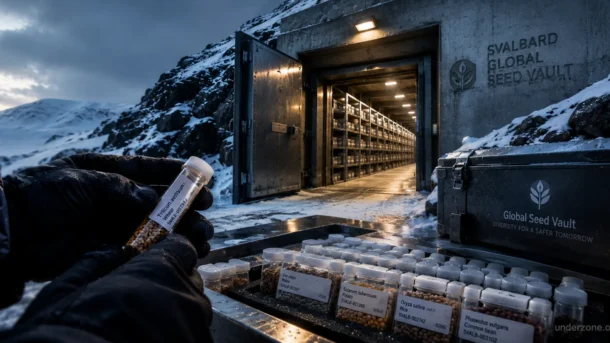
Deep inside a frozen mountain on a remote Arctic island, millions of seeds are waiting for a future that may never come.
The Svalbard Global Seed Vault, opened in Norway in 2008, was built to protect one of humanity’s most important resources: the genetic diversity behind our food supply. Its purpose is simple but extraordinary. If a seed collection elsewhere in the world is destroyed by war, disaster, or neglect, a duplicate may survive in Svalbard.
The vault is buried deep inside a mountain on the Arctic archipelago of Svalbard. Its seeds are stored at −18°C, sealed in protective packages and kept in conditions designed for long-term preservation. The facility can hold up to 4.5 million seed samples, and by 2026 it safeguards more than 1.4 million.
Yet the most interesting part of the vault is not its size. It is what the seeds represent.
A Backup of a Backup
The vault does not usually collect seeds directly from farmers or wild fields. Instead, it receives duplicates from gene banks that already preserve crop varieties. These institutions remain responsible for their original collections, while Svalbard provides another layer of protection.
The arrangement is deliberately restrictive. Depositors retain ownership of their seeds, and only the institution that deposited a collection can withdraw it. The vault is not a public seed shop or a storehouse that governments can simply open whenever they choose.
This system has already proved its value. When conflict threatened the International Center for Agricultural Research in the Dry Areas and its collections in Syria, the organisation withdrew stored duplicates from Svalbard. Those seeds helped rebuild collections in Lebanon and Morocco.
The vault was not waiting for the end of the world. It was helping repair damage that had already happened.
What the Vault Cannot Save
The name can create a misleading impression: that humanity has stored a backup of nature itself.
It has not.
The vault focuses on seeds that can be dried and kept at low temperatures. Some important crops, including bananas and many varieties of potato, cannot be preserved this way in the same form. They require other conservation methods, such as maintaining living plants or storing plant tissue.
Nor can seeds preserve the knowledge needed to grow food. They cannot replace healthy soil, reliable water, farming skills, functioning supply chains, or the communities that know how particular crops survive in particular places.
A packet of seeds may contain the genetic potential for a resilient crop. Turning that potential into food still requires people and a world in which they can work.
Preserving Possibility
The Svalbard Global Seed Vault is often imagined as a monument to catastrophe, a place built for the day civilisation fails. Its quieter purpose is more practical: protecting options before they disappear.
A crop variety that seems unimportant today may carry a trait that future farmers need to withstand a disease, a changing climate, or a new growing season. Once a unique variety is lost, the information encoded in its genes may be impossible to recover.
The vault cannot guarantee that humanity will always have enough food. It cannot preserve every plant or solve the problems that threaten agriculture.
What it can do is keep some possibilities alive.
Deep beneath the Arctic rock, the future of food is not being stored as a finished solution. It is being stored as a collection of chances humanity may one day need.