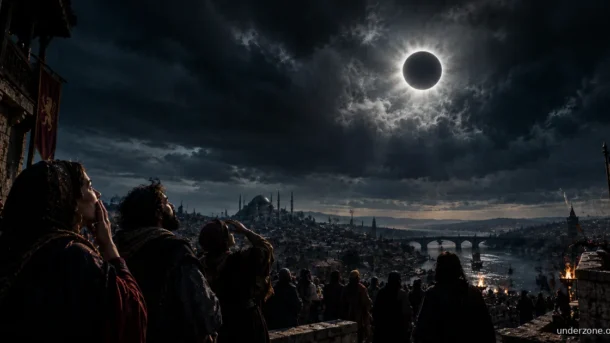
Imagine looking out of your window at midday and discovering that the world has turned almost completely dark.
No sunset. No approaching night. Just darkness arriving while the day should be at its brightest.
On May 19, 1780, this happened across much of New England, in what became known as the Dark Day.
When daylight stopped making sense
The darkness began during the morning and grew so intense in some places that people needed candles to read or carry out ordinary tasks. Birds fell silent, farm animals behaved as though night had arrived, and familiar surroundings became difficult to see.
For people who had no modern instruments to explain the phenomenon, the event was deeply unsettling.
Some interpreted it as a sign of the end of the world. Others searched for a natural explanation.
One of them was Samuel Williams, a Harvard professor who recorded observations and collected accounts from across the region. He suspected that extensive fires might be responsible.
At the time, he had evidence—but no way to confirm the full picture.
The clue hidden in trees
More than two centuries later, researchers examined fire scars preserved in tree rings in Canada. Their findings linked the event to major wildfires in the northern United States and Canada.
The likely explanation was a combination of wildfire smoke and atmospheric conditions that made the darkness unusually severe.
In other words, the Sun had not vanished. Its light was being blocked before it could reach the ground.
The research, published in 2007, supported the explanation that Williams had considered back in 1780.
Yet some details of the event remain difficult to reconstruct precisely, including how conditions varied from place to place.
The mystery behind the mystery
The Dark Day is a reminder that people can witness something real without immediately understanding its cause.
To those who experienced it, the darkness seemed almost impossible. Their fear was understandable: the sky had changed, ordinary life had stopped, and the explanation was beyond their reach.
But the most fascinating part of the story may be what happened afterward.
A clue survived inside the growth rings of trees for generations, waiting for someone to read it.
Sometimes, the past leaves evidence in places no one thinks to look.
The Sun never disappeared. For a few extraordinary hours, the world simply lost its light—and the answer took centuries to emerge.