
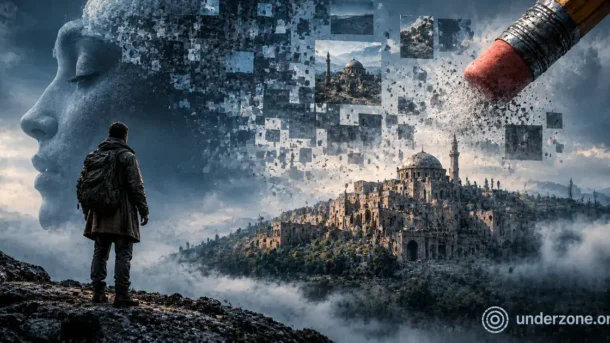
Imagine standing beside a lake and looking across its calm surface. Beneath the water, there may be streets, houses, gardens and places where people once lived their ordinary lives. Somewhere below, a village that once appeared on maps has become almost invisible.
But places do not always disappear because they are physically destroyed. Sometimes, they vanish in a quieter way: people stop speaking about them, their names disappear from records, and eventually, even their existence becomes difficult to remember.
So how does an entire place fade from human memory?
When a Village Becomes Part of a Lake
One striking example can be found in Greece.
The village of Kallio, formerly known as Velouchovo, was submerged when the Mornos Dam was completed in 1979. The reservoir was created to help supply water to Athens, and the rising water covered the old settlement.
For the people who had lived there, this was not simply a change to the landscape. Their homes, familiar streets and memories were left beneath the water.
Yet Kallio did not disappear completely.
During periods of drought, when the reservoir level falls, the remains of the old village begin to emerge. Ruins that have spent years underwater return to view, briefly revealing a settlement that the modern landscape seems to have forgotten.
It is an unusual reminder that a place can disappear from everyday life without ever truly ceasing to exist.
The Disappearance That Happens Without Water
Other places vanish without being flooded or physically destroyed.
Small settlements can lose their populations as people move towards larger towns. Buildings remain standing, but the communities that gave them meaning gradually disappear.
Over time, local names are forgotten. Old photographs lose their context. Family histories become disconnected from the locations where they began.
In some cases, a place survives only in administrative documents, old maps or the memories of a few remaining people.
This is where physical disappearance and historical disappearance become two different things.
A building can survive for centuries while the story behind it is lost within a generation.
Who Decides What History Remembers?
History is often presented as a collection of important events, powerful people and famous locations. But the survival of a place’s story depends on something less visible: whether someone continues to preserve it.
Large cities have archives, museums and institutions dedicated to remembering their past. Smaller communities are not always so fortunate.
When records are destroyed, populations move away or local traditions disappear, an entire chapter of history can become difficult to reconstruct.
Sometimes, the evidence still exists. It simply remains unnoticed.
An old photograph in a private collection, a forgotten name on a map or the foundations of a building beneath modern streets may reveal a history that was never completely erased.
Can a Place Really Be Forgotten?
Perhaps the most unsettling part is that forgetting does not always require destruction.
A place can remain physically present while disappearing from collective memory. Its buildings may still stand, its streets may still exist, but the stories that once made it meaningful are no longer told.
And when the last person who remembers those stories is gone, what remains?
Perhaps a name. Perhaps a photograph. Or perhaps nothing that immediately tells us that thousands of ordinary moments once unfolded there.
The disappearance of a place is not always the end of its existence.
Sometimes, it is simply the beginning of its absence from memory.