
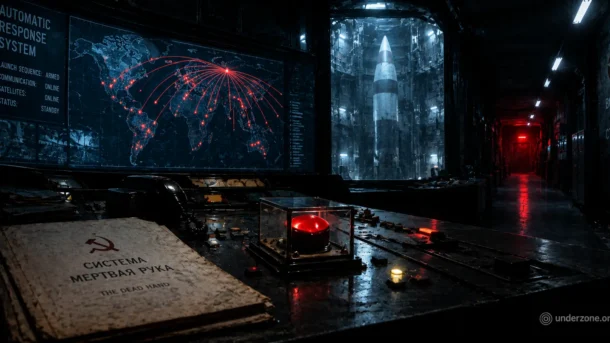
Imagine a nuclear war in which the first explosion destroys not only cities, but also the people responsible for ordering a response.
Who gives the order after the command structure has disappeared?
During the Cold War, the Soviet Union developed a system intended to address precisely that nightmare. It became known in the West as Dead Hand. Its official Russian name was Perimeter.
But the truth behind its reputation is more complicated than the story of a machine that automatically starts the end of the world.
Built for a world without commanders
Perimeter was deployed in 1985, during one of the most dangerous periods of the Cold War.
Soviet military planners feared a nuclear first strike that could destroy Moscow, eliminate senior commanders and sever the communication networks controlling the country’s nuclear forces.
The problem was not simply how to survive an attack. It was how to preserve the ability to respond after the people normally responsible for giving orders were gone.
Perimeter was designed as part of the answer.
What did it actually do?
The popular version describes an automatic system that detects a nuclear attack and launches a retaliatory strike without human involvement.
However, the system’s publicly documented role was more complicated.
Perimeter included special command rockets capable of flying over Soviet territory and transmitting launch orders to surviving missile units if normal communication channels had been destroyed.
In other words, it helped ensure that an order could still reach the forces.
According to nuclear weapons expert Pavel Podvig, Perimeter was primarily a backup communication system, not an independent machine deciding to start a nuclear war. Soviet planners had considered more automatic operating modes, but the extent to which such capabilities were actually used remains disputed.
The part that remains unsettling
The system raises a disturbing question about human control.
What happens when a military system is designed to keep functioning after its normal leadership has disappeared?
A 2020 report by the Stockholm International Peace Research Institute described a semi-automated process in which the system could transfer decision authority to personnel inside a protected bunker under certain extreme conditions.
More recent analysis in September 2026 brought renewed attention to underground command facilities associated with the system. Yet experts continue to disagree with the popular description of Dead Hand as a fully autonomous doomsday machine.
Its precise current capabilities remain difficult to establish from public information.
A machine, a promise, or a warning?
The most unsettling aspect of Perimeter may not be its technology.
It is the idea behind it: a nuclear response should remain possible even when the people who normally control it can no longer communicate.
The system was intended to prevent an enemy from believing that destroying the leadership would eliminate the threat of retaliation.
But there is a deeper paradox.
A system designed to prevent nuclear war must preserve the ability to carry it out under circumstances in which human control may be severely damaged.
Perhaps the real mystery is not whether a machine can end the world by itself.
It is how much human control can survive after everything has gone wrong.