
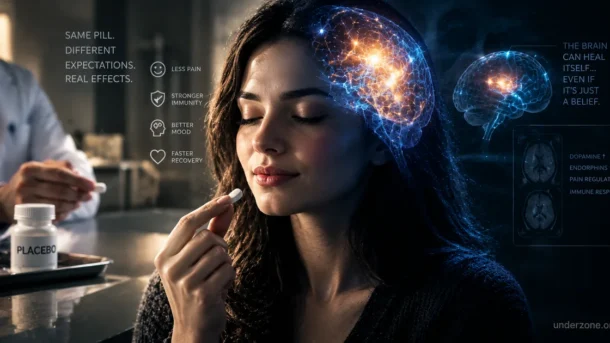
Imagine taking a pill that contains no active medicine—and still feeling your pain begin to fade.
Nothing in the pill is designed to relieve the pain. Yet, for some people, something changes.
This is the placebo effect, one of the more intriguing phenomena in medicine. It raises an uncomfortable question: how much of what we experience depends not only on what happens to our bodies, but also on what we expect to happen?
When Expectation Becomes Physical
A placebo is an inactive treatment, often used in medical research to compare a new treatment against something that looks similar but contains no active ingredient.
The surprising part is that an inactive treatment can still produce real changes in how a person feels.
Pain is one of the clearest examples. Research suggests that expectations, previous experiences, and the circumstances surrounding treatment can influence how pain is processed by the brain. In some cases, the brain’s own pain-regulating systems become involved.
This does not mean the pain was imaginary. The experience was real; the factors influencing it were simply more complicated than the contents of a pill.
But there is an important distinction: feeling better after taking a placebo does not automatically prove that the placebo itself caused the improvement. Symptoms can naturally fluctuate, and people may improve for other reasons.
The Other Side of Belief
If expecting relief can sometimes help, can expecting harm make things worse?
Researchers call this the nocebo effect.
When people expect negative symptoms, that expectation can contribute to symptoms such as increased pain or nausea. The effect varies between individuals, but research shows that negative expectations and anxiety can influence what people experience.
The implication is fascinating. The mind does not simply observe the body like a detached spectator. Under certain circumstances, expectations can become part of the body’s response.
And this influence does not always require a conscious decision. We may react to familiar routines, past experiences, or the way a treatment is presented without fully understanding why.
What Belief Cannot Do
It would be tempting to conclude that the mind can heal almost anything. But the evidence does not support that conclusion.
Placebo effects can influence symptoms and certain physiological responses, but they are not a universal cure. They cannot be relied upon to eliminate an infection, remove a tumour, or replace an effective treatment.
Belief is powerful in some contexts, but it is not unlimited.
That boundary matters. Otherwise, a genuine scientific phenomenon becomes a myth—and patients may be blamed when positive thinking fails to cure an illness.
So, Where Does Reality Begin?
The placebo effect challenges a simple assumption: that physical experience is determined entirely by physical treatment.
What we expect can sometimes influence what we feel. What we feel can be biologically real, even when the treatment itself contains no active medicine.
Perhaps the deeper mystery is not whether belief can replace reality, but how closely our expectations and physical experiences are connected.
The pill may contain nothing.
The response it triggers may not.