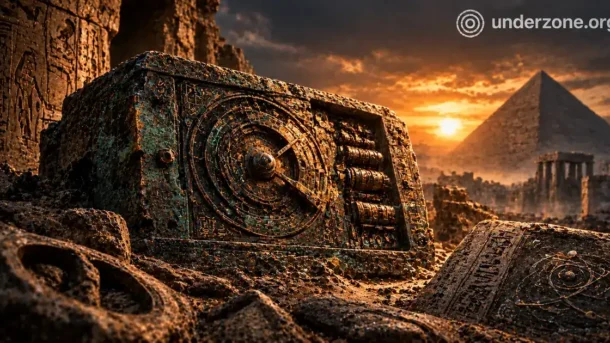
More than 2,000 years ago, someone built a machine that could calculate the movements of celestial bodies using an intricate arrangement of bronze gears.
It was not a clock in the modern sense, nor merely a decorative astronomical instrument. The Antikythera Mechanism was a hand-operated calculator that modelled astronomical cycles, including the movements of the Sun and Moon and the prediction of eclipses.
Its existence raises a question more unsettling than how it worked: if the ancient world could build a machine this sophisticated, how much of its technological knowledge disappeared without a trace?
A Machine Recovered from the Sea
In 1901, sponge divers exploring an ancient shipwreck near the Greek island of Antikythera recovered corroded bronze fragments. At first, the remains looked like little more than a lump of metal.
Closer examination revealed something extraordinary: tiny gear teeth, inscriptions, and components that belonged to a complex mechanical device.
The machine was probably constructed during the second or first century BCE. Today, its surviving pieces are divided into dozens of fragments, preserving only part of the original mechanism.
Modern X-ray imaging and digital analysis have helped researchers examine details hidden inside the corroded metal. They have reconstructed much of its gearing and identified evidence of a device designed to represent astronomical cycles.
The machine was not advanced because it anticipated modern electronics. It was advanced because it transformed mathematical relationships into a working mechanical system.
What Did It Actually Do?
A user could turn a control and move pointers across a series of dials. The gear trains translated that movement into information about celestial cycles and calendars.
The mechanism could track the relationship between solar and lunar time and help predict eclipses. Its inscriptions also indicate that its designers considered the movements of the planets known to ancient Greek astronomy.
This was not a machine that independently discovered the laws of the universe. It embodied astronomical knowledge already developed through observation, mathematics, and earlier traditions of science.
That distinction makes the device no less remarkable. Someone had to combine those ideas with precise metalworking, carefully calculated gear ratios, and a sophisticated understanding of mechanical motion.
The Antikythera Mechanism was not simply a collection of clever parts. It was knowledge made physical.
The Missing Technology Around It
The mechanism is often described as a device centuries ahead of its time. But that phrase can create the wrong impression, as if it appeared in an otherwise technologically primitive world.
Ancient writers referred to astronomical instruments and mechanical devices, suggesting that the Antikythera Mechanism belonged to a broader, though poorly preserved, tradition of technical experimentation.
The real problem is survival.
Bronze could be melted down and reused. Wooden casings decay. Machines break, and their parts are separated from the people who understood them. Knowledge that once circulated among craftspeople can disappear when workshops close and their methods are no longer taught.
The Antikythera Mechanism survived largely because it sank with a ship and remained underwater until its wreck was discovered.
Its preservation was accidental. Countless other objects may have had no such luck.
A History Written by What Remains
We know the mechanism existed because a small portion of it survived. We know far less about how many similar machines were made, who built them, who used them, or how widely their techniques spread.
It would be wrong to conclude that an entire advanced technological civilisation vanished. The evidence does not support that claim. The mechanism demonstrates sophisticated ancient engineering, not a lost industrial age.
But it does expose a weakness in how we imagine technological progress. The past is not a complete archive. It is a collection of surviving fragments, and those fragments can make entire traditions appear smaller than they really were.
The Antikythera Mechanism did not arrive from nowhere. It emerged from knowledge that was accumulated, practised, and eventually lost in ways we cannot fully reconstruct.
Its greatest mystery may not be how ancient people built such a machine.
It may be how many other achievements disappeared before anyone thought to preserve them.