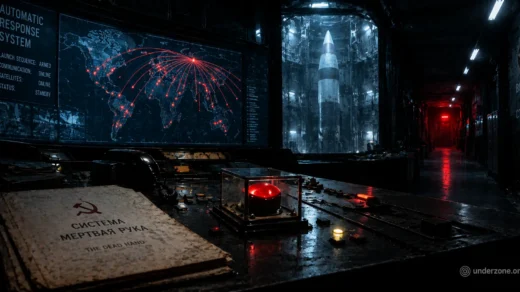

May 23, 1967. Somewhere beneath the United States, military officers were watching a situation they could not afford to misunderstand.
Three enormous radar installations, positioned thousands of kilometres apart, had suddenly become unreliable.
Their purpose was simple: detect incoming Soviet missiles before they could reach North America.
Now, all three appeared to be experiencing severe interference.
During the Cold War, this was not an ordinary technical failure. An attempt to blind America’s missile warning system could be interpreted as the opening move of a nuclear attack.
And nobody knew what was happening.
The Enemy Nobody Could See
The radar installations were part of the Ballistic Missile Early Warning System, known as BMEWS.
One stood in Alaska. Another was in Greenland. The third was in Britain.
Together, they watched the northern skies for signs of a Soviet missile launch.
But on that May afternoon, their signals were being overwhelmed.
Military commanders had to consider a frightening possibility: the Soviet Union might be deliberately interfering with the warning system to conceal an attack.
American forces began increasing their readiness.
Additional nuclear-capable aircraft were placed on ready-to-launch status. These were not ordinary patrol preparations. They were part of a system designed to respond to a potential nuclear emergency.
Yet the suspected enemy had not fired a single missile.
Something Was Happening on the Sun
Thousands of kilometres away from the military command centres, astronomers were observing an extraordinary event.
The Sun had become intensely active.
On May 23, a powerful solar flare produced an enormous burst of radio emissions. Those emissions reached Earth and overwhelmed radio signals used by the radar installations.
The Sun was effectively creating interference that looked, from a military perspective, remarkably similar to deliberate electronic jamming.
There was another complication.
The radar stations were positioned in high northern latitudes, where their antennas could receive the Sun’s powerful radio emissions directly.
The source of the interference was not hiding behind the horizon.
It was shining above them.
The People Who Were Watching the Sun
There was, however, one group of people who understood that something unusual was happening.
Inside NORAD’s Solar Forecast Center, military space-weather specialists had been monitoring solar activity.
Colonel Arnold L. Snyder was among those on duty.
When the command post asked whether solar activity might explain the interference, Snyder recalled responding:
“Yes, half the sun has blown away.”
It was an extraordinary way to describe an extraordinary observation.
His team had information that could change how military commanders interpreted the entire situation.
The suspected Soviet interference was consistent with a powerful solar radio burst.
As the solar emissions weakened, the radar interference also began to diminish.
The evidence pointed away from an enemy attack and toward the star at the centre of our own solar system.
The War That Did Not Begin
The additional aircraft were not launched.
Information from the solar forecasting network reached military decision-makers in time to help prevent the incident from escalating.
The immediate radar interference passed, but the larger solar disturbance was not finished.
Over the following days, communications across the United States and Canada continued to suffer disruptions. The resulting geomagnetic storm became one of the most significant space-weather events of the twentieth century.
Researchers later reconstructed the incident using scientific records and accounts from retired military personnel.
They concluded that the event could have had catastrophic consequences if the solar explanation had not been recognised in time.
There is no evidence that a nuclear launch was seconds away, and the story should not be mistaken for a confirmed near-launch. But it exposed a genuine danger: a natural event could be mistaken for an act of war.
The Most Unexpected Enemy
We often imagine that a world war begins with a decision made by a human being.
A leader gives an order. A missile is launched. An army crosses a border.
But on May 23, 1967, the danger came from somewhere no military could attack, negotiate with, or intimidate.
The Sun had no intentions. It had no political ambitions. It did not know that its radiation was interfering with machines designed to detect the end of the world.
And yet, for a brief and dangerous moment, its activity became part of the machinery of the Cold War.
Humanity had built systems capable of starting a nuclear catastrophe. It had not yet fully learned how to distinguish an enemy attack from the behaviour of its own star.